 Get the facts on NF1 and breast cancer
Information for Health Care Professionals

Through our research, in partnership with the Patient Led Research Hub – University of Cambridge, we have found that many healthcare professionals struggle to access clear guidelines on Neurofibromatosis Type 1 (NF1), as there are currently no dedicated National Institute for Health and Care Excellence (NICE) guidelines.
Our research has now been published in an open-access paper in BMJ Open Quality: ‘Alone on our NF1 island’: a patient-led mixed-method survey study to understand the care pathway for neurofibromatosis type 1 (NF1) patients in the UK | BMJ Open Quality
To address this gap, we aim to simplify the process of caring for individuals with NF1 by providing access to comprehensive resources, including the ERN GENTURIS guidelines. While these are European guidelines and some recommendations may differ in the UK, they represent the most thorough and reliable guidance currently available.

Training
A clear and comprehensive explanation of NF1 is available as a downloadable PDF. It has been developed to help health professionals across all disciplines to: understand the disease, appreciate the importance of diagnosis, recognise signs in undiagnosed patients, and make prompt and appropriate referrals.
Reviewed by:
- Dr Jude Hayward MRCP MRCGP DRCOG MSc (Genomic Medicine) GP/GPwER; Leeds Clinical Genomics Service and Primary Care Lead NHSE Genomics Education Programme
- Dr Will Evans MSc MRCGP, GP and GPwER; Leeds Clinical Genomics Service
Use for self-learning, teaching and professional development

Lisch nodules
Tiny raised brown spots in the iris.
Speciality: ophthalmology, optometry
Optic pathway glioma (OPG)
A tumour on the optic pathway, sometimes causing problems with vision, such as objects becoming blurred, changes in colours, a reduced field of vision, squinting and one eye more prominent than the other.
Speciality: ophthalmology, optometry, oncology
Coffee-coloured patches, or café au lait spots
Café au lait spots around 5mm across in chidren and 15mm across in adults
Speciality: dermatology, health visitor, general practitioner (GP)
Freckling
A cluster in unusual places such as the armpits, groin and under the breast.
Speciality: dermatology, health visitor, general practitioner (GP)
Neurofibromas
Cutaneous and subcutaneous neurofibromas (non-cancerous tumours) can grow on nerves anywhere on the body, on or under the skin. They can be visible and cause irritation and stinging.
Plexiform meurofibromas are often larger and can cause more problems. The skin over them might look or feel different, have extra hair growth and they can sometimes be painful or change how a part of the body looks.
Speciality: dermatology, urology, gastroenterology, plastic surgery, health visitor, general practitioner (GP)
Learning and behavioural problems
While most children will have an average, or above IQ, they may need different teaching methods to help them fully engage with learning. Common associated traits are autism and ADHD, dyslexia or dyscalculia, sensory processing difficulties, problems with coordination, speech and language difficulties and memory difficulties.
Speciality: paediatrics or child psychology/educational psychology
Neurological manifestations
Headaches/migraines, ataxia, visual disturbances, seizures, nerve pain, gait disturbances.
Brain tumours (while very rare) can cause personality changes, weakness on one side of the body, difficulties with balance and coordination, Epilepsy.
Speciality: neurology, orthopaedics, educational psychology
Mental health
Visual differences may lead to feelings of social isolation and depression. The burden of inheritance can also weigh heavily on patients.
Speciality: counselling service, psychology, dermatology, plastic surgery
High blood pressure
Can be caused by narrowing of the kidney or by a phaeochromocytoma (a usually benign tumour of the adrenal glands).
Speciality: cardiology, nephrology, pulmonology, endocrinology, general practitioner (GP)
Breast Cancer
Women with NF1 have a 5-fold increased risk of developing breast cancer under the age of 50.
Speciality: breast screening centre, oncology
Gastrointestinal tumour (GIST)
Addominal pain, change in bowl habits, such as constipation or diarrhoea, bleeding from then rectum.
Speciality: gastroenterology, oncology
Fine and gross motor skills
Problems with fine and gross motor skills, mobility and function.
Speciality: physiotherapy occupational therapy
Glomus tumours
Glomus tumours are benign tumours that form around the nail bed in the fingers or toes. Sometimes they lead to purple discolouration around the nail bed.
Speciality: surgery
Physical development
Larger than average head size. Smaller size and lower weight than average. Hypermobility
Speciality: orthopaedics, endocrinology, dietician
Malignant peripheral nerve sheath tumour (MPNST)
Some plexiform neurofibromas can change form into a malignant peripheral nerve sheath tumour (MPNST) which is a type of cancer. Changes to look out for can include a plexiform neurofibroma changing from soft to hard, or suddenly growing much larger, persistent pain for more than a month or waking you at night, sudden problems with the nervous system, such as weakness, numbness or tingling in arms and legs, loss of bladder or bowl control, difficulty breathinhg or swallowning.
Speciality: oncology, urology, gastroenterology, ENT
Bones osseous lesions (problems with bones mnot due to injury)
Scoliosis (curvature of the spine), pseudarthrosis which is an abnormal bone development causing curving of the limb, usually the tibia bone of the lower leg, or sphenoid dysplasia which is a condition where there’s a malformation of the sphenoid bone
Speciality: orthopaedics, endocrinology
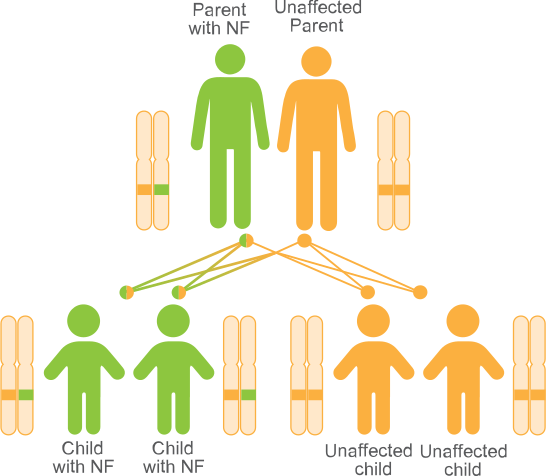
Genetics
A risk of having a child with NF1.
Speciality: geneticist, family planning
Diagnostic criteria for Neurofibromatosis Type 1 (NF1)

A pathogenic NF1 gene variant**

- The term “mutation” is no longer accepted; pathogenic variant is now the preferred term.
- Genetic analysis is not REQUIRED for diagnosis but may allow for an earlier diagnosis.
- Genetic analysis ALONE is not sufficient to diagnose NF1 – diagnosis requires a second diagnostic feature of NF1.
A parent with NF1 based on diagnostic criteria
Glossary
Body Map for Early Identification of Neurofibromatosis
Why is a Body Map Important?
A Body Map provides a simple, clear way to record birthmarks and skin features—especially café-au-lait spots, which are one of the early signs of Neurofibromatosis Type 1 (NF1). It can also be useful for documenting Mongolian blue spots and in safeguarding contexts. By noting and monitoring these marks, healthcare professionals and parents can support earlier identification and timely referrals.

If a baby or child presents with any visible birthmarks or café-au-lait spots, we recommend downloading and printing the Body Map and placing it in their Red Book or similar child record. Accurately recording these markings can play a crucial role in facilitating timely assessment, support, and diagnosis.
Insert for the Red RCPCH Child Development Book
A concise guide tailored to include in the Royal College of Paediatrics and Child Health Red Book, this insert provides vital information for families and healthcare professionals tracking development milestones and care needs for children with NF1.
